Table of Contents
Hearing, Cognition and Tinnitus
Research on causes of congenital and acquired deafness and its relation to cognition. Research on tinnitus, hyperacusis, age-induced and noise-induced hearing loss and neuropathies in animal models and patients.
Senior Investigator: Prof. Dr. rer. nat. Marlies Knipper

Phone: +49 (0)7071 - 29 88244
Fax: +49 (0)7071 - 29 4950
marlies.knipper@uni-tuebingen.de
Prof. Dr. rer. nat. Lukas Rüttiger
Phone: +49 (0)7071 - 29 88260
Fax: +49 (0)7071 - 29 4950
lukas.ruettiger@uni-tuebingen.de
Department of Otolaryngology, Head and Neck Surgery
Tübingen Hearing Research Centre
Elfriede-Aulhorn-Strasse 5
D-72076 Tübingen
Germany
Hearing and Cognition
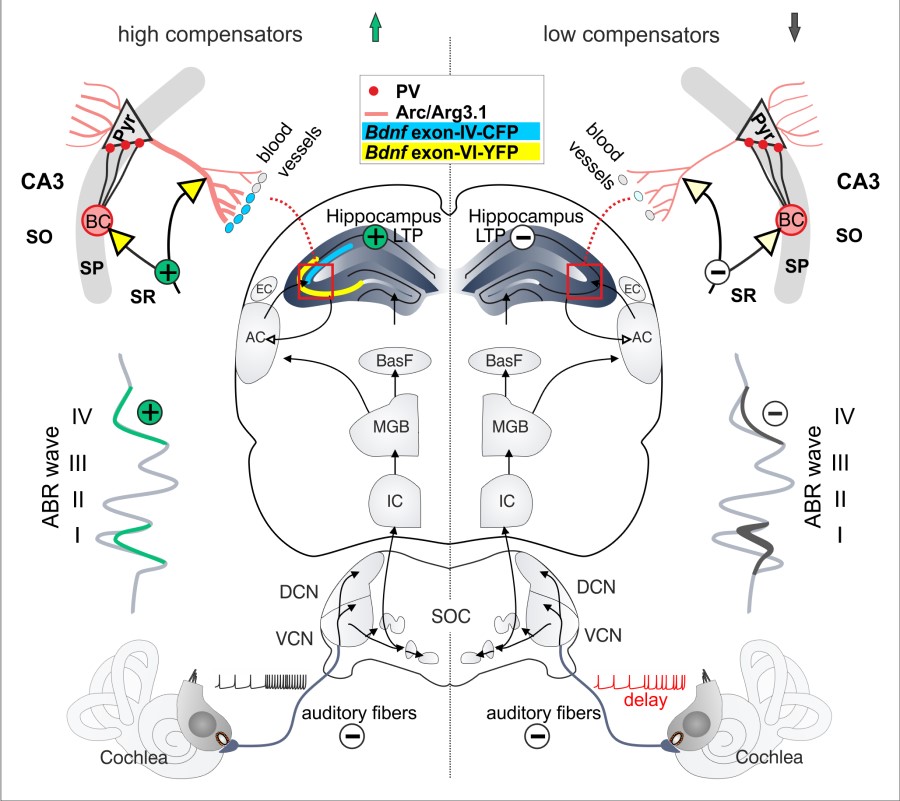
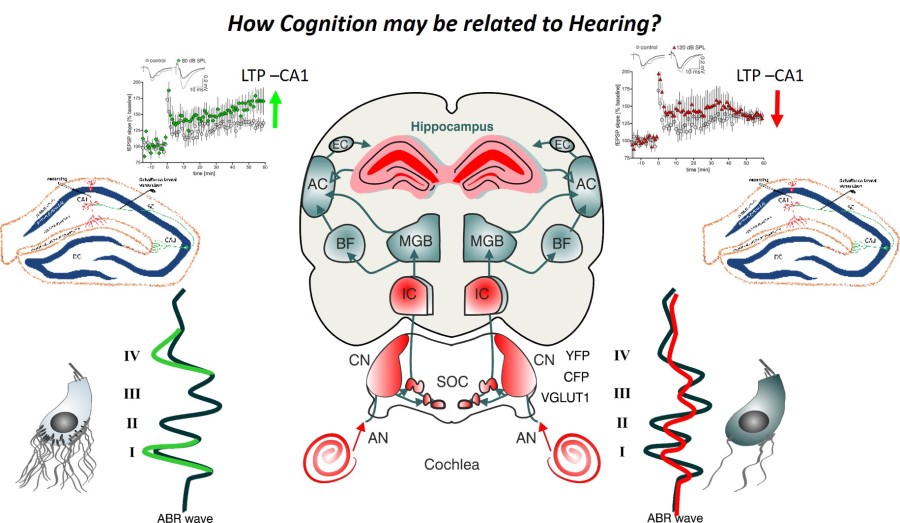
Fast auditory processing may be an essential driving force for recruitment of activity-dependent auditory-specific BDNF expression, and central memory-dependent adjustment to auditory deprivation. Age-dependent cochlear synaptopathy, if centrally compensated through enhanced input/output function (neural gain), can prevent age-dependent temporal discrimination loss. Finally we newly observed that latency of auditory nerve processing, recruitment of hippocampal LTP, and BDNF transcription, are key factors for age-dependent auditory processing deficits, more than cochlear synaptopathy or aging per se.
Our goal & our challenge
Future research aims to elucidate the relation between fibers with high spontaneous firing rate (high-SR) involved in fast auditory processing and memory-linked adjustment processes in the context of the high risk of hearing loss for dementia.
Our methods Audiometry, fine structure audiometry, hippocampal LTP/LTD measurement, animal behavioural studies, ASSR, EEG.
Marchetta et al., 2020, Brain. Sci.
Stress and Hearing
Systemic glucocorticosteroids have been the mainstay of treatment of various hearing disorders for over 30 years. Numerous studies described glucocorticosteroids and stressors to protect the auditory organ, particularly outer hair cells. We focus on the role of stressors for inner hair cell synapses, pre-and postsynaptic integrity of IHCs synapse and auditory nerve fibers and its relation to central memory-linked auditory processing and adjustment processes.
Our goals To understand how stressors influence the auditory processing in the periphery of the cochlea and thereby central auditory processing and how changes in stress-related central plasticity feed-back to the auditory nerve processing.
Our methods Generation and analysis of e.g. MR/GRCaMKIIαCreERT2 KO mice, ABR, fine structure analysis of ABR, temporal auditory processing as ASSR, LTP/LTD in combination with pharmaceutical therapeutic intervention.
Hearing and Age
Age-related hearing loss (ARHL), or presbycusis, is one of the most common conditions affecting older and elderly adults. While age-related decoupling of auditory nerve fibers from hair cells (cochlear synaptopathy) has been linked to temporal processing deficits and impaired speech recognition performance, the link between both is elusive.
Our goals We aim to improve identification and diagnostic of different forms of age-dependent speech discrimination deficits and develop therapeutic strategies to overcome these.
Our methods Pharmaceutical approaches and investigations of non-invasive stimulation devices.
Eckert et al., 2021, Front Mol Neurosci.
Hearing, Tinnitus and Hyperacusis
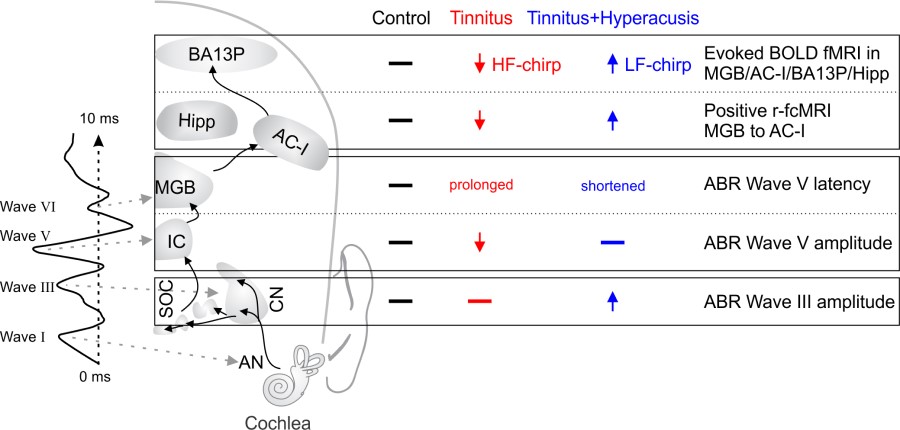
To each person their tinnitus, none is the same, but distress is a common denominator. Depending on the intensity, this constant ringing in one or two ears can be a personal tragedy with a highly negative impact on quality of life, while others come to terms with it. Tinnitus, a very common condition, affects approximately one-sixth of the general population. A curative therapy for tinnitus currently does not yet exist, and its progress is mostly impeded by the existing controversial views about the neural correlate of tinnitus that, depending on predictions, either would require the suppression or the enhancement of brain activity. We hypothesized that the variability of tinnitus, with or without the co-occurrence of hyperacusis (T- or T+H), contributed to this dilemma.
Our goals We aim to identification objective tools and functional biomarkers that enable to distinguish tinnitus with and without hyperacusis. Having these new tools in hand our group's aims, in cooperative work that include clinical studies and multi-centric studies with harmonized methodology, to validate existing curative therapies and develop new ones.
Our Methods Characteristic brain activities or patterns for both T- and T+H-groups, extracted through a combination of psychometric tests, fine-structured audiometry, and functional imaging (evoked and resting state BOLD fMRI).
cGMP signalling and Pharmacological treatments
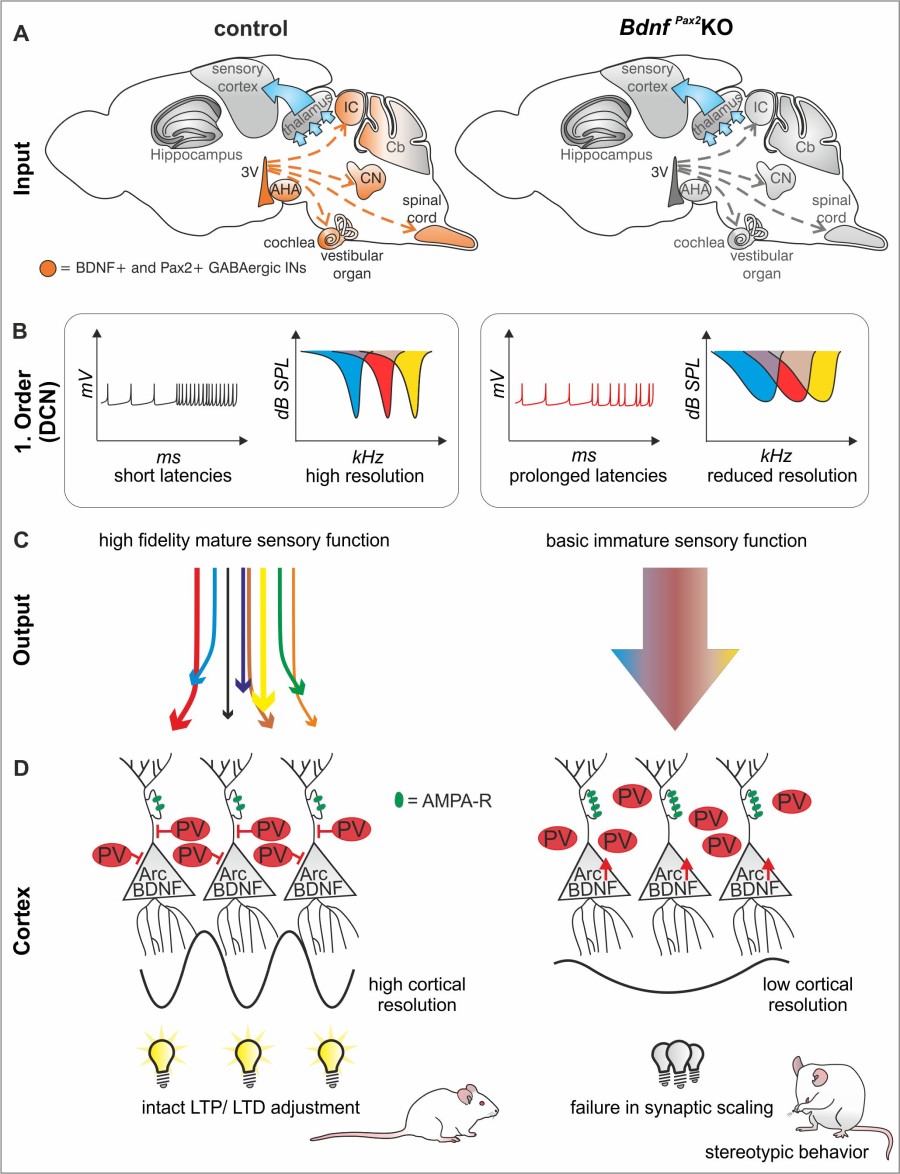
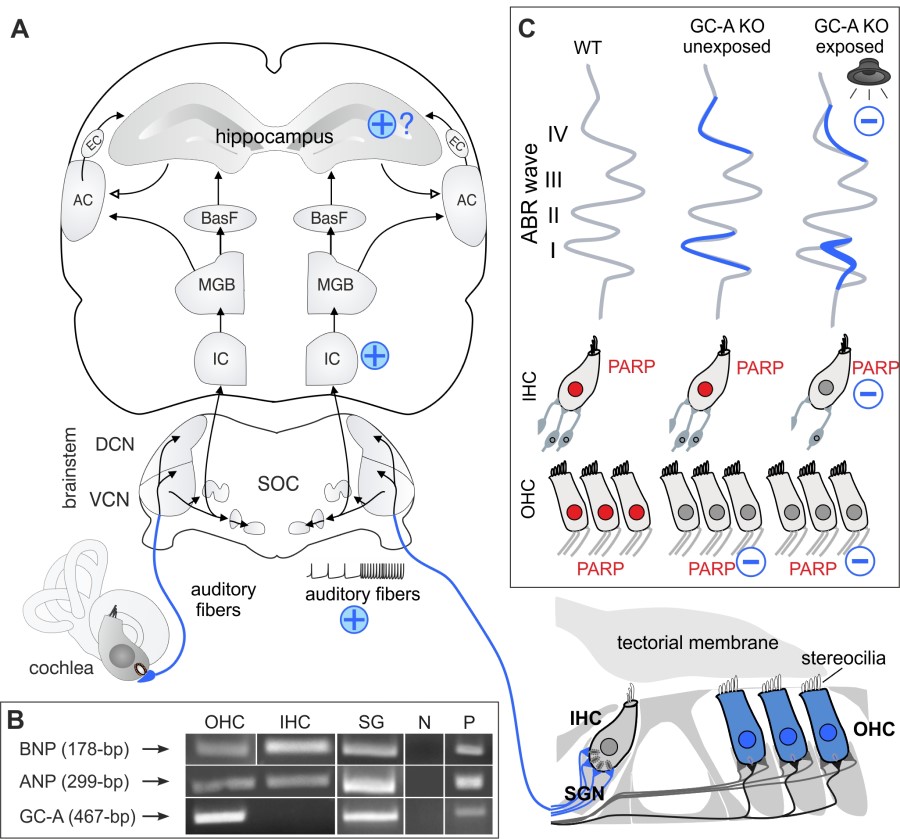
Soluble Guanylyl Cyclase (sGC) is critical for the integrity of the first synapse in the ascending auditory pathway, the inner hair cell (IHC) synapses. GC-A promotes hair cell stability under stressful conditions such as acoustic trauma or ageing. GC-B plays a role in the development of efferent feedback and gain control (see for review Marchetta P et al. 2021).
Our goals Regarding the crucial role hearing has for language development, speech discrimination, and cognitive brain functions, a most challenging topic of future work is to examine to what extend a differential pharmaceutical targeting of GC may offer therapeutic promise for the restoration of hearing and related cognitive and age-dependent deficits.
Our Methods Pharmacological test of drugs that target specific GC-subtypes or cGMP signalling cascades.
Marchetta P et al. 2021, Br. J. Pharmacol.
Team
Senior Principal Investigators
| Prof. Dr. rer. nat. Marlies Knipper | Prof. Dr. rer. nat Lukas Rüttiger | Dr. rer. nat. Wibke Singer |
| |  |  |
| marlies.knipper@uni-tuebingen.de | lukas.ruettiger@uni-tuebingen.de | wibke.singer@uni-tuebingen.de |
| +49 (0)7071 - 29 88244 | +49 (0)7071 - 29 88260 | +49 (0)7071 - 29 88246 |
Research Scientists
| Dr. Csaba Harasztosi | Dr. Stefan Fink |
 |  |
| csaba.harasztosi@uni-tuebingen.de | stefan.fink@uni-tuebingen.de |
PhD Students
| Morgan Hess | Konrad Dapper | Joanna Ibrahim Bacha |
 |  |  |
| morgan.hess@uni-tuebingen.de | konrad.dapper@uni-tuebingen.de | joana.ibrahim-bacha@uni-tuebingen.de |
Current Med Doctoral Students
| Jakob Schirmer | Antonia-Marlene Kohl | Elinor Riegger |
Technical
| Nadine Heckmann |
 |
| +49 (0)7071 - 29 88268 |
Administration
| Kerstin Just |
 |
| kerstin.just@klinikum.uni-tuebingen.de |
| +49 (0) 7071 - 29 88242 |
Publications
